
Picture this: an old wire overheats behind your switchboard at 2 AM, and the only thing standing between that fault and a house fire is a small plastic switch you probably never think about. That’s exactly what an MCB does, and in cities where older buildings routinely skip proper earthing and circuit protection gets treated as an afterthought, your choice of MCB genuinely becomes the last line of defense between a faulty wire and a genuine electrical hazard.
Here’s why getting this right matters more than most people realise: a Miniature Circuit Breaker automatically trips when your circuit gets overloaded or short-circuits, protecting your wiring, appliances, and ultimately your family from fire risk. Unlike a fuse that needs replacing every time it blows, an MCB simply resets, but only if it’s genuinely built to trip accurately and consistently every single time. With so many brands crowding electrical stores, here are the five that consistently deliver on safety, reliability, and long-term performance.
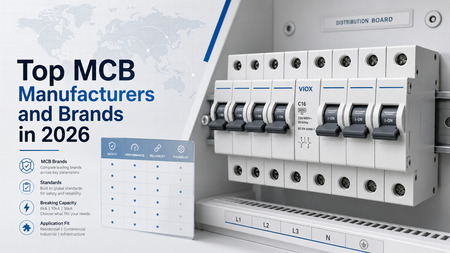
Schneider Electric
For most residential projects in India, Schneider Electric’s Acti9 series genuinely stands out as the strongest overall choice, offering a solid balance of safety, reliability, and value. Backed by a 5-year warranty and available in both 6 kA and 10 kA breaking capacity options, Schneider’s MCBs come equipped with features like VisiTrip indicators and integrated busbar compatibility, genuinely useful details that make installation and fault diagnosis considerably easier for electricians.
Established in 1836 and now headquartered in Gurugram for its Indian operations, Schneider brings genuine European engineering heritage combined with technologies like EcoStruxure to improve energy efficiency alongside safety. Its wide availability through authorised distributors and increasingly through quick commerce platforms makes it a genuinely practical choice whether you’re wiring a new home or urgently replacing a faulty breaker mid-project.
Havells
Havells genuinely holds its position as India’s largest and most recognised electrical appliance manufacturer, and its MCB range reflects exactly why homeowners and electricians default to this brand so consistently. Established in 1958, Havells now operates across 12 manufacturing sites within India alone, backed by thousands of engineers and a genuinely extensive distribution network that makes sourcing replacement parts considerably easier than with some premium imported alternatives.
What genuinely sets Havells apart is its combination of competitive pricing with solid quality, adhering to IS/IEC 60898-1 standards while remaining accessible for mass residential projects. For homeowners and contractors specifically working within a moderate budget without wanting to compromise on genuine safety certification, Havells consistently delivers the practical middle ground most Indian households actually need.
Legrand
Legrand has genuinely built a distinct reputation by pairing strong safety performance with premium aesthetics, and its DX³ MCB series reflects exactly this philosophy, offering 10 kA breaking capacity within a clean, modern design that fits naturally into high-end residential and commercial distribution boards. This French company, with over a century of experience in electrical and digital building infrastructure, genuinely ranks as India’s top MCB brand by market position according to several industry comparisons.
For homeowners specifically renovating premium properties where the electrical panel itself might be visible or where aesthetics genuinely matter alongside function, Legrand’s combination of robust protection and refined visual design makes it a genuinely compelling choice over more purely utilitarian alternatives.
Siemens
If tripping accuracy under pressure is genuinely your top priority, Siemens’ 5SL series has earned its reputation specifically through consistency, delivering exactly the right trip response every single time rather than occasionally varying under stress. Rated at 10 kA with a 5-year warranty matching Schneider’s assurance, Siemens genuinely suits industrial panels and large commercial installations where equipment protection depends entirely on precise, reliable tripping behaviour.
The genuine trade-off worth knowing about Siemens is procurement, since these MCBs are primarily available through authorised distributor networks rather than widespread retail presence, meaning lead times can stretch two to three days for specific ampere ratings or less common configurations. If you’re planning ahead for an industrial or large commercial project, this isn’t a concern, but if you need an urgent replacement today, Siemens’ more limited immediate availability genuinely matters.
ABB
ABB genuinely brings Swiss engineering credibility into India’s MCB market, offering a comprehensive range spanning residential, commercial, and industrial applications with the kind of global manufacturing scale that comes from serving clients across more than 100 countries. Homeowners specifically choosing ABB often cite the compact, visually unobtrusive design of its breakers alongside genuinely dependable protection against overloads and short circuits.
For fabricators and contractors working across diverse project types, ABB’s breadth genuinely means you can source most of your circuit protection needs from a single trusted manufacturer, reducing the complexity of managing multiple brand relationships across a larger installation, though its industrial-first positioning means it’s specifically favoured for demanding applications over purely budget residential work.
Getting the Technical Details Right, Beyond Just Brand Choice
Choosing the right brand only solves half the equation, the specific MCB you select genuinely needs to match your actual electrical load and application. Breaking capacity, measured in kA, indicates the maximum fault current your MCB can safely interrupt, for most standard residential homes, a 6 kA rating is genuinely sufficient, while commercial or industrial installations typically warrant 10 kA options for added safety margin.
Trip curve type matters just as much, C-curve MCBs are genuinely the standard recommendation for most Indian homes, offering solid protection against both overloads and short circuits while accommodating the moderate inrush current from typical household appliances. Getting professional installation from a qualified electrician, rather than attempting this yourself, genuinely ensures your MCB is correctly matched to your panel and wiring, since even the best brand won’t protect you properly if it’s improperly installed or mismatched to your circuit’s actual requirements.
Frequently Asked Questions
Q1. Is it worth paying more for a premium brand like Schneider or Siemens over a budget option for a standard home installation?
For your main distribution board and critical circuits, yes, genuinely, the reliability difference in tripping accuracy and long-term durability matters considerably for safety-critical protection, though budget, ISI-certified brands remain reasonably safe choices for non-critical circuits or temporary installations where cost is the primary concern.
Q2. What’s the difference between 6 kA and 10 kA breaking capacity, and which do I genuinely need for my home?
This refers to the maximum fault current the MCB can safely interrupt without damage, most residential homes genuinely only need 6 kA capacity given typical household electrical loads, while 10 kA is generally reserved for commercial buildings, industrial panels, or homes with unusually high-demand electrical setups.
Q3. Can I mix different MCB brands within the same distribution board, or should everything genuinely match?
While technically possible in many cases, it’s generally advisable to stick with one brand throughout your panel for consistency in performance characteristics and easier troubleshooting later, and you should always verify compatibility with your specific distribution board’s manufacturer guidelines before mixing brands.
Q4. How long should a genuine, quality MCB from these top brands actually last before needing replacement?
A properly installed MCB from a reputable brand should genuinely function reliably for decades under normal household use, though it’s worth periodically testing the trip mechanism manually, using the built-in test button, every six months or so to confirm it’s still tripping correctly rather than assuming it remains functional simply because it hasn’t tripped recently.





Leave a Reply